Independent shop owner
A retailer wants nearby searchers to find accurate hours, products, directions, and current customer feedback.
A complete local presence supports discovery before a customer chooses where to visit.
Local search guide
Local SEO is the practice of improving a business’s visibility in location-based search results. It connects nearby customers with accurate business information, useful local content, and credible signals across search and maps.

The short answer
Local SEO helps a business appear when people search for products, services, or places in a specific area. It is a focused part of digital marketing built around relevance, proximity, and trust.
Set expectations
Local SEO improves discoverability and helps searchers make confident decisions, but it cannot replace a strong business, accurate operations, or sustained customer service.
Search visibility changes by location, query, competition, relevance, and search context. No local SEO process can promise a permanent position.
What to do instead
Track priority searches over time and improve the signals your business can control.
A polished profile may earn attention, but inaccurate hours, missed calls, weak service, or unresolved complaints can still reduce conversions.
What to do instead
Keep business details current and connect visibility work with dependable operations and review responses.
Optimization helps a business get found for relevant searches; it does not make an unnecessary service desirable in every market.
What to do instead
Validate demand, define a useful local offer, and create content that answers real customer needs.
Local SEO is one channel within digital marketing. It does not automatically cover email, paid campaigns, social media, partnerships, or brand strategy.
What to do instead
Use local search as a durable foundation, then add channels that match the audience and sales cycle.
Working mechanism
The process is iterative: make the business understandable, prove its relevance, and improve the experience after people arrive from search.
Build a complete, consistent business presence with the correct name, category, address or service area, hours, contact details, and offerings.
Create useful pages and profile information that reflect what nearby customers search for, including services, locations, questions, and practical details.
Collect genuine customer feedback, respond thoughtfully, monitor visibility, and correct inaccurate information across important local sources.
Channel comparison
Both disciplines improve organic discovery, but local SEO adds geographic context and places extra weight on business information and nearby intent.
| Local SEO | Broader SEO | |
|---|---|---|
| Primary audience | People looking for a nearby business, service, or place | People searching for information, products, or services without a local focus |
| Core context | Location, service area, map presence, and local intent | Topic relevance, authority, content depth, and site structure |
| Important profile | Google Business Profile and other local business listings | Website pages, backlinks, technical signals, and content assets |
| Typical search result | Map pack, local finder, business profile, or location page | Organic web result, featured result, image, video, or product result |
| Useful proof | Reviews, accurate details, local relevance, and proximity | Expertise, topical coverage, links, engagement, and technical quality |
| Conversion path | Call, direction request, booking, visit, or local contact form | Reading, comparing, subscribing, purchasing, or completing an online task |
Visibility shift
The difference is not only appearing in search. A useful local presence gives people enough accurate information to decide what to do next.

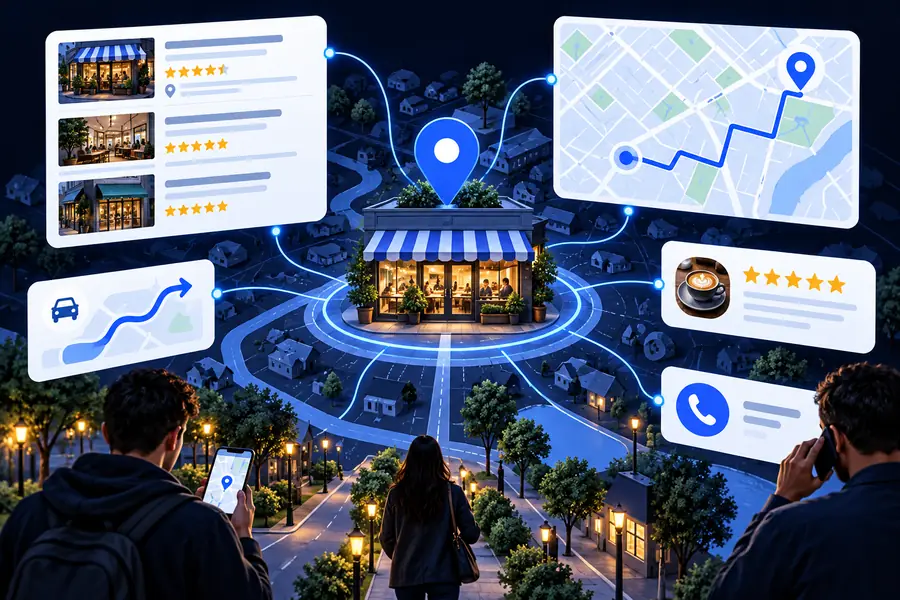
Visibility improves when relevance, accuracy, and trust work together.
Unclear local presenceUseful local presencePractical users
Local SEO applies to any organization that serves a defined place, whether customers visit a storefront, call a local team, or request service at their own address.
A retailer wants nearby searchers to find accurate hours, products, directions, and current customer feedback.
A complete local presence supports discovery before a customer chooses where to visit.
A plumber, cleaner, or contractor serves several neighborhoods without welcoming customers at one fixed storefront.
Clear service areas and relevant local pages help align visibility with the places the team can actually serve.
A consultant manages local search work for clients and needs a repeatable way to review profiles, visibility, and improvements.
A consistent process makes recommendations easier to explain and maintain across accounts.
A business with several branches needs each location to show the right address, hours, services, and local context.
Location-specific information reduces confusion and gives each branch a clearer search presence.
Next step
Start with the basics: accurate business information, a clear service focus, useful local pages, and a process for listening to customer feedback. Local SEO becomes more effective when every signal supports the same real-world business.
Common questions
Local SEO is the process of improving a business’s visibility for searches connected to a place, service area, or nearby need. It contributes to digital marketing by helping relevant local customers discover, evaluate, and contact the business through search and map experiences.
Local SEO can help a small business appear when people nearby are actively looking for its products or services. Accurate details, useful information, and credible reviews can reduce uncertainty and support actions such as calls, visits, bookings, or direction requests.
The main parts include accurate business listings, a well-maintained Google Business Profile, relevant location or service content, consistent contact information, and genuine customer reviews. Ongoing monitoring is also important because business details, competitors, and search behavior change.
Traditional SEO usually focuses on improving visibility for broader searches through content, authority, and technical quality. Local SEO includes those principles but adds geographic relevance, map visibility, business profile signals, proximity, and local customer trust.